

Author: Site Editor Publish Time: 2025-04-21 Origin: Site


Notice on Laboratory Safety in Chinese Higher Education Institutions in 2025 and List of Laboratory Safety Inspection Items in Chinese Higher Education Institutions (2025)
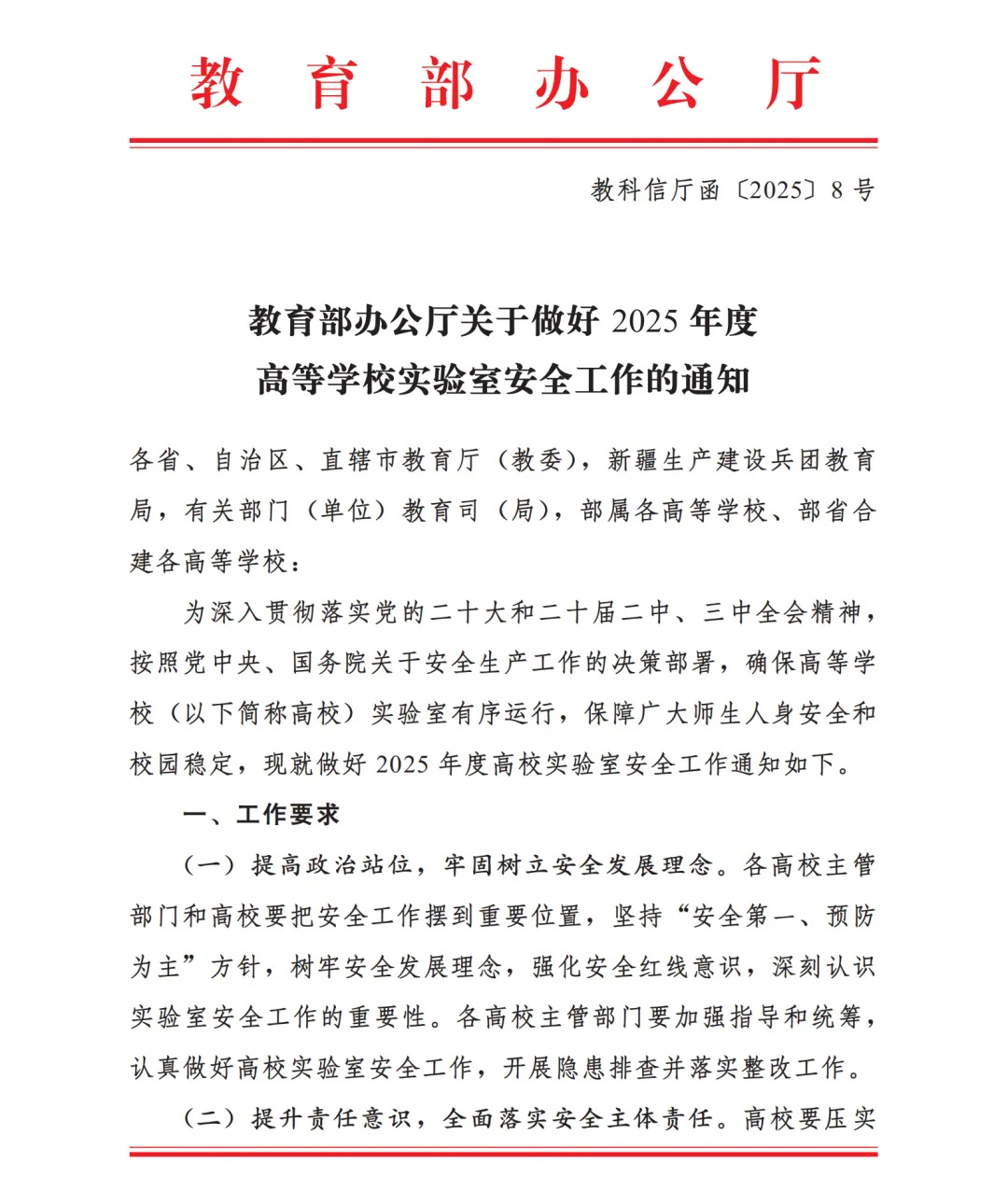
On March 25, 2025, the General Office of the Ministry of Education of China issued the document "Notice of the General Office of the Ministry of Education of China on Doing a Good Job in Laboratory Safety in Higher Education Institutions in 2025 (Tongkexinhan [202] No. 8). In order to promote laboratory safety construction, Titanium TRIGHT has specially compiled relevant materials for your reference.
Notice of the General Office of the Ministry of Education of China on Doing a Good Job in Laboratory Safety in Chinese Higher Education Institutions in 2025 (Tongkexinhan [202] No. 8)
Comparison of changes in the laboratory safety inspection project table of Chinese higher education institutions in 2025 and 2024
Category 1 Responsibility system
1.4.1 Implementation of reward and punishment mechanism to positions or individuals
2024: The key points of the inspection are "whether there are clear reward and punishment management methods, and the actual implementation situation" (emphasizing questions about the existence of the system).
2025: Modified to "whether there are clear reward and punishment management methods, and the actual implementation situation" (directly requiring the existence and implementation of the system, weakening the form of questions).
Category 2 Safety inspection
5.2.1 Safety inspection at the school and department level and laboratory self-inspection
2024: Clarify the quantified inspection frequency: "School-level inspections shall be conducted no less than 4 times a year, department-level inspections shall be conducted no less than 1 time a month, and laboratories shall be inspected frequently".
2025: Adjusted to "Safety inspections shall be carried out at the three levels of school, department, and laboratory at a frequency not less than the inspection frequency required for laboratory safety grading and classification management. Safety inspections and rectifications shall be recorded.", cancel the specific frequency, and emphasize classification management.
Category 3 Safety Facilities
7.5.1 Explosion-proof Laboratory Design Requirements
2024: Specific equipment requirements such as "explosion-proof switches, explosion-proof lamps, etc., as well as necessary gas alarm systems, monitoring systems, emergency systems, etc." are listed.
2025: Summarized as "Laboratories with explosion-proof requirements should use explosion-proof electrical equipment. Explosion-proof lamps, explosion-proof electrical switches, dust removal devices, wire laying, etc. should meet the overall explosion-proof requirements; necessary gas alarm systems, monitoring systems, emergency systems, etc. should be installed", and the technical requirements are more principled.
Category 4 Chemical Safety
9.3.3 Total Storage Limits for Hazardous Chemicals
2024: Supplementary explanation "Adjust the storage volume according to the laboratory area of 50m²".
2025: Delete the area ratio and directly stipulate that "In the same fireproof unit, the amount of hazardous chemicals (excluding compressed gas and liquefied gas) should not exceed 100L or 100Kg in principle, of which the total amount of flammable and explosive chemicals should not exceed 50L or 50Kg, and a single packaging container should not be larger than 20L or 20Kg.".
9.5.1 Management of highly toxic chemicals
2024: Require "highly toxic chemicals to implement "five pairs" management" (i.e. two-person acceptance, two-person custody, two-person delivery, two locks, two books), and technical defense measures to meet regulatory requirements.
2025: Simplified to "highly toxic chemicals should be stored separately, and a two-person receiving and sending, two-person custody system should be implemented, and technical defense measures should meet regulatory requirements."
9.7.2 Requirements for pretreatment of chemical waste
2025: Add "hazardous wastes should be classified, collected and temporarily stored according to their chemical properties and hazardous properties. Under normal conditions, unstable substances must be stabilized before entering the hazardous waste treatment process", emphasizing safe disposal.
Category 5 Biosafety
10.7.2 Classification and disposal of biological waste
2024: Requirement that "biological waste involving pathogenic microorganisms or other bacteria must be sterilized at high temperature and high pressure or treated with chemical immersion, and then finally disposed by a qualified company".
2025: The terminology is revised to "biological waste involving pathogenic microorganisms or other infectious organisms must be sterilized at high temperature and high pressure or treated with chemical immersion, and then finally disposed by a qualified company", covering a wider range.
Category 6 Radiation Safety
11.1.1 Scope of Radiation Safety License
2024: Described as "conducting experiments within the permitted range of radionuclide types and dosages and radiation types in accordance with regulations. Except for those exempted from management, radiation devices, radiation sources or unsealed radioactive materials should be included in the scope of the license".
2025: Clearly require "conducting radiation experiments in the permitted radiation activity site in accordance with the types and scope of activities specified in the radiation safety license. Except for those exempted from management by the ecological environment department, radiation devices, radiation sources or unsealed radioactive materials should apply for radiation safety licenses", strengthening site compliance.
11.3.1 Radioactive Device Operation Specifications
2024: Requires "focusing on gamma irradiation, electron accelerators, X-ray flaw detectors, non-sealed radioactive experimental operations, and sealed radioactive experimental operations above Class V".
2025: Refine to "focusing on gamma irradiation, electron accelerators, X-ray flaw detectors, non-sealed radioactive experimental operations, and radioactive source experimental operations above Class V".
Laboratory safety is a long road with no end, which requires us to continue learning, exploring and practicing. As the guardian of university laboratories, Titanium TRIGHT has the responsibility to provide every teacher and student with a safe, healthy and efficient experimental environment. Let us work together to build a solid line of defense for laboratory safety and escort the starry sea of scientific exploration.

